MIT Prof. Ramesh Raskar: The Internet of AI Agents: Why AGI Won’t Be One “God Model”?
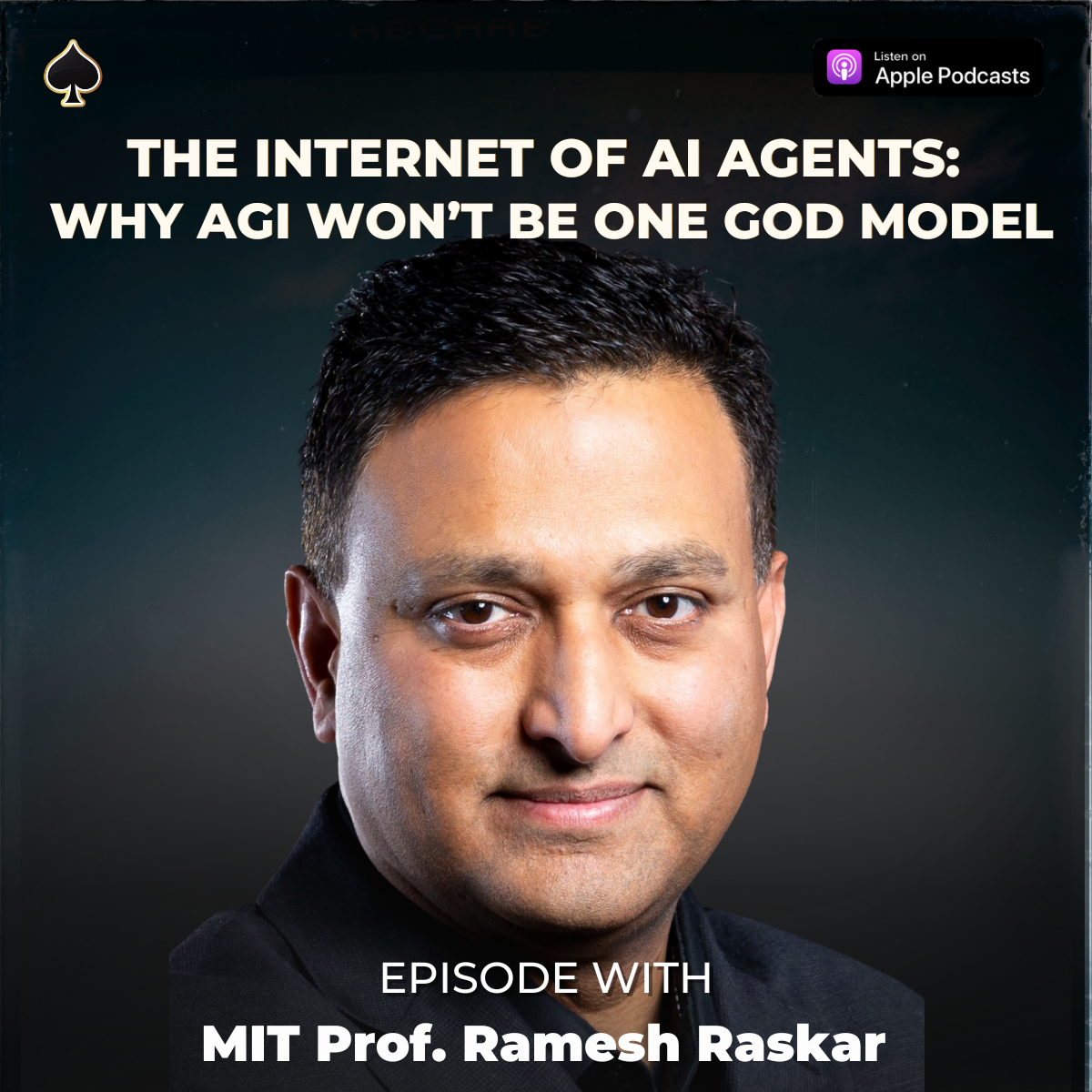
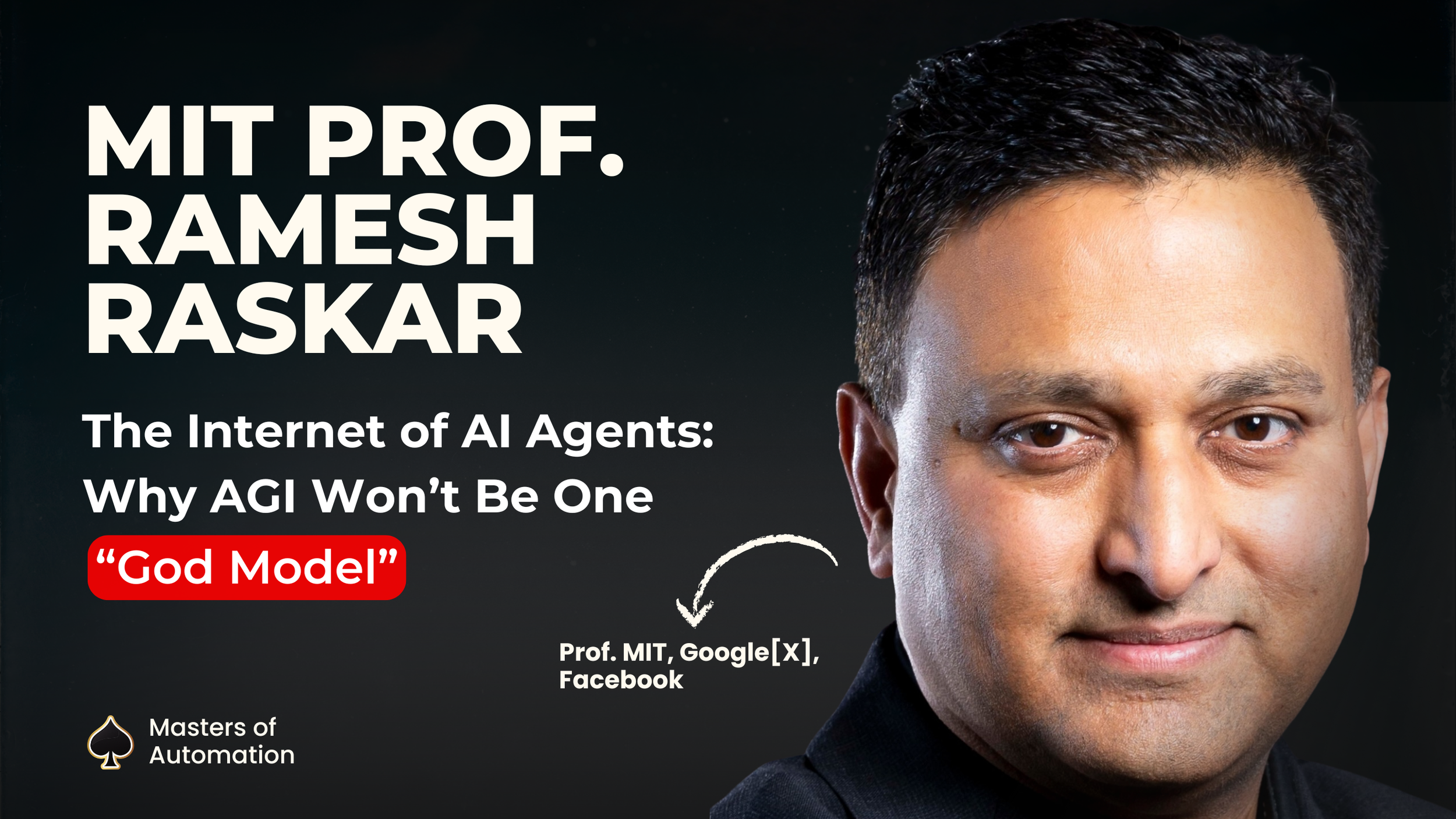




The following is a conversation between Alp Uguray and Professor Ramesh Raskar.
Summary
In this episode of Masters of Automation, Alp Uguray sits down with MIT Professor Ramesh Raskar to explore a future where AI shifts from centralized “foundries” (massive cloud models) to a world of personal, edge-based agents that we own, customize, and connect—an Internet of AI Agents (see Project NANDA).
Raskar traces his journey from a small town near Nashik—where curiosity and constraint shaped his mindset—to being inspired by Jurassic Park, then “waking up” to the power of storytelling and human realism through South Park, which ultimately pulled him from computer graphics into machine learning and systems thinking. From there, the conversation dives into his core thesis: the next frontier isn’t bigger models—it’s AI that’s closer to your data, your context, and your control.
They unpack the idea of Agent Zero (a private AI agent for every person), how agents might evolve through foundations → commerce → societies, and why the next big economic layer may be agent teaming/orchestration rather than models or apps. They also confront the two diverging futures: a “quiet dystopia” dominated by a few agent stores versus a “green curve” world of billions of micro-AIs empowering global creativity and shared prosperity. The episode closes with Project NANDA—Raskar’s effort to build core infrastructure for trust, naming, certification, interoperability, and ongoing attestation in an open agentic ecosystem (open-source repo, research paper).
Guest Bio
Professor Ramesh Raskar is an MIT professor and researcher known for building ambitious, system-level technologies spanning computer vision, machine learning, human-computer interaction, and decentralized AI. Across academia and industry, he has worked on problems at the intersection of intelligence, networks, and real-world impact—from early work in research labs like Mitsubishi Electric Research Laboratories (MERL) to leading initiatives that connect AI with security, trust, and societal-scale coordination. In this episode, he shares his vision for Agent Zero and Project NANDA (Networked AI Agents in Decentralized Architecture)—a proposed foundation for a safer, open “agentic web.”
Takeaways
Your origin story matters: constraint + curiosity can become a superpower when you keep learning relentlessly.
The frontier isn’t bigger—it’s closer: AI value shifts when models live near your data, context, and needs.
Foundry → Garage → Bazaar: centralized AI is necessary early, but the natural evolution is toward edge ownership and then networked commerce.
Agent Zero: the case for “an agent for every citizen” that’s private, authenticated, and usable even in low-connectivity environments.
Centralization creates consumers; decentralization creates creators—but the future needs a balance, not extremism.
Agent foundations matter: naming, identity, certification, interoperability, and attestation become essential infrastructure (think ICANN + DNS + certificate authorities).
The next economic battleground: not just models/apps—agent teaming and orchestration may capture the most value.
A new capitalism emerges: specialized agents priced by performance, reliability, and live reputation (think FICO scores for agents).
Healthcare’s bottleneck is locked decentralization: silos kill network effects—agents could enable privacy-preserving markets for knowledge and outcomes (in a world shaped by HIPAA constraints).
Two futures: a quiet dystopia of a few agent stores vs. a green curve with billions of micro-AIs and shared prosperity.
Chapters
00:00 Origins in Nashik: libraries, curiosity, and the “nature doesn’t negotiate” mindset
02:20 Jurassic Park → computer graphics; South Park → functional realism → machine learning
06:15 Choosing depth over hype: why meaningful problems beat money-first decisions
07:55 Foundry vs. garage vs. bazaar: the long arc of compute, networks, and AI
12:38 “We rent intelligence and give away our data” — why ownership flips the model
16:59 Agent Zero: an agent for every person, regardless of wealth or bandwidth
21:16 Agent foundations → commerce → societies (and why a “telephone exchange” for agents is inevitable)
30:50 Knowledge pricing + agent markets: “FICO scores” for quality, reliability, and trust
40:45 Why agent evals are harder than LLM evals (and what might replace “LLM-as-judge”)
42:48 Healthcare: population AI, privacy, and unlocking global health intelligence
54:49 The workforce fork: quiet dystopia (red curve) vs. creator economy (green curve)
01:04:10 Robotics reality check: why manipulation is still the hard frontier
01:20:59 Project NANDA: naming, certification, interoperability, attestation—and avoiding the “agentic app store trap”
01:25:40 Closing
“The future is about billions of micro AIs, each of us having our own agent.”
“Centralization gives you efficiency, but decentralization gives the robustness.”
“Inventing problems is more fun than inventing solutions.”

Long Bio:
Ramesh Raskar is an Associate Professor at MIT Media Lab, director of the Camera Culture research group and leader of the program on Decentralized AI. His focus is on Machine Learning and Imaging for health and sustainability. They span research in physical (e.g., sensors, health-tech), digital (e.g., automated and privacy-aware machine learning) and global (e.g., geomaps, autonomous mobility) domains.
In his recent role at Facebook, he launched and led innovation teams in Digital Health, Health-tech, Satellite Imaging, TV and Bluetooth bandwidth for Connectivity, VR/AR and 'Emerging Worlds' initiative for FB.
At MIT, his co-inventions include camera to see around corners, femto-photography, automated machine learning (auto-ML), private ML, low-cost eye care devices (Netra,Catra, EyeSelfie), a novel CAT-Scan machine, motion capture (Prakash), long distance barcodes (Bokode), 3D interaction displays (BiDi screen), new theoretical models to augment light fields (ALF) to represent wave phenomena and algebraic rank constraints for 3D displays(HR3D).
Before MIT, he co-invented techniques for AR, Computational Photography, Shader Lamps (projector-AR), composite RFID (RFIG), multi-flash non-photorealistic camera for depth edge detection, quadric transfer methods for multi-projector curved displays.
In July 2020, Raskar testified before the U.S. House Committee on Financial Services Task Force on Artificial Intelligence. He spoke about the use of technology, particularly contact tracing and exposure notification, in managing the COVID-19 pandemic. He highlighted the PathCheck Foundation's work (which he chairs) in developing privacy-preserving contact tracing tools. He is the co-inventor of the privacy preserving digital contact tracing solution (later known as exposure notification), which led CDC to recommend the approach broadly.
He received the Royal Photographic Society Award for Imaging Science in 2024, National Academy of Inventors 2024, Lemelson Award 2016, ACM SIGGRAPH Achievement Award 2017, Technology Review TR100 award 2004 (which recognizes top young innovators under the age of 35), Global Indus Technovator Award (top 20 Indian technology innovators worldwide) 2003, Alfred P. Sloan Research Fellowship award 2009 and Darpa Young Faculty award 2010. Other awards include Marr Prize honorable mention 2009, LAUNCH Health Innovation Award, presented by NASA, USAID, US State Dept+ NIKE, 2010, Vodafone Wireless Innovation Award (first place) 2011.
His work has appeared in NYTimes, CNN, BBC, NewScientist, TechnologyReview and several technology news websites..
His invited and keynote talks include TED, Wired, TEDMED, Darpa Wait What, MIT Technology Review, Google SolveForX and several TEDx venues.
His co-authored books include Spatial Augmented Reality, 3D Imaging and books under preparation include Computational Photography and ‘Spot-Probe for AI Ventures’
He has worked on special research projects at Google [X], Facebook, Apple and co-founded/advised several startups. He launched REDX.io, a platform for young innovators to explore AI-for-Impact. He frequently consults for dynamic organizations to conduct 'SpotProbing' exercises to spot opportunities and probe solutions.
He holds 100+ US patents.
[Personal webpage http://raskar.info] http://www.media.mit.edu/~raskar
Specialties: Health-tech, Digital health, Computer Vision, Machine Learning, Imaging, Optics, Displays, Sensors, Medical Imaging, RFID, Projector, VR-AR, Computation Photography, HCI, Tech-Transfer, Ventures, Startups
Transcript
Alp Uguray (00:00.45):
Cool—so to kick things off, I love starting with your journey and origin story. You grew up in Nashik, your father served in the military, and your family had deep roots in the community. Somewhere in that environment, you developed this incredible curiosity about technology and what’s possible.
I read that watching Jurassic Park—seeing those special effects—sparked something in you about computer graphics and building imaginary worlds. Can you take me back to that time? What was it about that moment or that period that made you think, “I want to build things like that”?
MIT Prof. Ramesh Raskar (00:45):
Yeah. I come from a small town well outside Mumbai—about 200 kilometers out. Most of my extended family were farmers in agriculture. And when you’re in farming, you realize nature does not negotiate. You have to figure out how to make it work. My father wasn’t a farmer, but the rest of the family was, so I learned a lot.
There was curiosity, but not much else to do—so I spent a lot of time in the city library reading books. I did my engineering, did well, started my PhD—and then Jurassic Park came out in the mid-90s. It was like, “Wow, this is amazing. I want to build that.” I love geometry, I love math, and it felt like the perfect combination: how to create special effects using computer code.
Since then, I’ve been mesmerized by images. I joke with colleagues in other fields: they build this whole thing and in the end they just get a number on the command line and know something worked. But in computer graphics or computer vision, you see an image—you see something real. It’s instant verification.
Then I saw South Park in the late 90s and thought: this is as entertaining as Jurassic Park—and it doesn’t use fancy effects. That made me realize storytelling matters. So I abandoned computer graphics as my core direction and moved toward machine learning.
Alp Uguray (02:19.426):
That’s really cool. What about South Park made you think that? Was it the storyline, the characters, the representation?
MIT Prof. Ramesh Raskar (02:40):
It’s a cartoon. Even the shadows are just circles. The interactions aren’t realistic—sometimes they don’t even look at each other. But it’s hilarious. It made me realize human emotions don’t need photorealism. They need functional realism.
Back then, most applications of computer graphics were entertainment and games. Nvidia was a new company, and colleagues were joining to build better gaming tech. It didn’t feel like the right thing for me. Of course, I was “wrong” in the sense that Nvidia went on to do much more than games—but at the time, that’s how I saw it.
Alp Uguray (04:05.624):
That’s contrarian—everyone goes one direction, you went another. What happened next after you made that decision?
MIT Prof. Ramesh Raskar (04:20):
Two things. First: I’m attracted to hard problems. Computer vision, machine learning, and human-computer interaction are difficult—and that’s exciting.
Second: the scope of what you can solve felt limitless—space imaging, transportation, agriculture, and more. It’s like the whole world becomes your lab.
After my PhD, it was the dot-com era. Colleagues were joining Yahoo, AltaVista, Google—stock options exploding. I was confused because that didn’t excite me. I wanted to do something deeply scientific. So I joined Mitsubishi Electric Research Laboratories (MERL) in Cambridge—like a Bell Labs for computer vision and HCI.
When I interviewed, I asked people why they weren’t leaving for startups and IPOs. They said, “We love what we’re doing here.” That was a strong signal. They had no stock options—just good research and a retirement plan—and I still chose it. Throughout my life, I’ve chosen depth, meaning, and passion over money or instant fame. And it has worked out.
Alp Uguray (06:15.554):
So it’s solving difficult problems versus going where the money is—especially today with the AI arms race.
MIT Prof. Ramesh Raskar (06:30):
Money should be a secondary goal. The best intersection is an amazing problem + real impact.
I tell people: you need something for your mind, something for your heart, and something for your wallet. You’re very lucky if one thing satisfies all three. Otherwise, it’s okay if you need multiple projects. It’s similar to Ikigai.
Alp Uguray (07:54.840):
You’ve worked in computer graphics, cameras, robotics, multimedia—also at places like Google X and Facebook. Today you’re advocating decentralized AI: split learning, edge intelligence, data staying local. What do you think everyone’s missing?
MIT Prof. Ramesh Raskar (08:20):
This centralization vs decentralization debate is interesting, but to me it’s also predictable.
In every field you have: foundry era → garage era → bazaar era.
Computing had mainframes (foundry), PCs (garage), then the internet (bazaar). Mainframes were centralized; PCs empowered individuals; the internet connected everything.
So I’m surprised we’ve stayed so long in the foundry era for AI—where data, compute, talent are centralized: huge salaries, massive clusters, even nuclear power plant-scale energy talk. That phase is necessary. There’s nothing “wrong” with it.
But if you look 3–5 years ahead, we move into the garage era: AI on the edge. You and I can create our own AI, train or fine-tune our own models, choose architectures, share notes. Then the bazaar era is when billions of agents and micro-AIs communicate and coordinate.
Does that mean companies like OpenAI are doing it wrong? No—foundry era is required early. But you should also prepare for the shift toward edge ownership and networked agents.
And it’s already happening: Nvidia released Nemotron. Microsoft has the Phi small language models. And you see progress in compact models globally.
Alp Uguray (12:37.708):
Right now it’s like ownership vs renting. We rent intelligence, and we give away data. Most compute happens elsewhere. Five years from now, how does that world look?
MIT Prof. Ramesh Raskar (12:55):
It’s absurd: we pay to rent models, and we give them data that makes them better.
Once we can run—and even train—models on our own devices, we mostly pay for electricity. Benefits: privacy, low latency, and rapid innovation. Once people own micro-models, innovation accelerates.
Also: scale isn’t only “intelligence.” Scale is often compression. The next frontier isn’t bigger—it’s closer: closer to your data, your context, your needs.
Alp Uguray (16:58.592):
I want to talk about “Agent Zero”—a private AI for every citizen. How do you imagine that working?
MIT Prof. Ramesh Raskar (17:15):
We started talking about “an agent for every person” years ago—before ChatGPT. People thought it was impossible because hosting costs were enormous. But we’re almost there. You can run a lot locally now, with a mirror in the cloud if needed.
We called it Agent Zero—the base personal agent. It’s like the mainframe era when people said, “a computer on every desk.” Here it’s “an agent for everyone.” Regardless of wealth, bandwidth, or political system, everyone should have an agent that is secure, authenticated, private, and ethical.
The moment that happens, decentralization unlocks creativity. Centralization tends to create consumers; decentralization creates owners and creators.
(For context on the “Agent Zero for every citizen” framing, see: MIT NANDA & India’s DPI — Agent for every citizen.)
Alp Uguray (18:54.156):
How would it be executed? Like an app on your phone running locally without sending data out?
MIT Prof. Ramesh Raskar (19:10):
Smartphone is a reasonable starting point—but the agent shouldn’t be seen as “just an app.” It’s diffused across your life: email, messages, WhatsApp, desktop—like the movie Her. It interacts through different surfaces.
Technically it might begin as an app, but you’ll likely also want a replica in the cloud for recovery, authentication, and interoperability. If my agent talks to your agent, we need an “exchange,” like a telephone system.
We describe phases: agent foundations → agentic commerce → agentic societies. Foundations include authentication, trust, registries, certification. Commerce is how agents earn/spend, find jobs, transact. Societies is where agents form organizations, even “justice systems.”
Alp Uguray (23:03.054):
Do you think the internet becomes a network of agents—less about static websites and more about my agent negotiating for me?
MIT Prof. Ramesh Raskar (23:20):
For consumers, that sounds like utopia. But businesses will resist because they want the direct relationship.
If you ask your agent for an Uber, Uber wants you in their app to upsell, show ads, build a flywheel. They don’t want to be intermediated. Same with shopping: too little friction hurts sales. There’s a sweet spot where people browse and discover.
So the UX will evolve. You might see “agentic friction”—ads or steps before an agent completes an action. It’ll be fascinating.
And for entrepreneurs: this feels like 1995. Take existing ideas and “agentify” them. You’ll also see entirely new categories: agent repair shops, agent universities, even “agent churches” to instill values.
Alp Uguray (28:24.502):
So intelligence multiplies with many agents collaborating rather than one AGI-like model?
MIT Prof. Ramesh Raskar (28:35):
Exactly. This goes back to Marvin Minsky’s Society of Mind: intelligence is many components working together.
Even centralized models are moving toward decentralization via mixtures of experts and tool-using workflows. The natural progression is that each person runs their own specialist agent, and when a task appears, agents discover and collaborate in real time.
That’s when a new capitalism emerges: specialists pricing their work. And we need mechanisms for knowledge pricing—pricing data and models.
Alp Uguray (32:23.726):
So agents could be priced like markets—better accounting agents charging more?
MIT Prof. Ramesh Raskar (32:40):
Yes, and quality can fluctuate—like pump-and-dump behavior. We need infrastructure to validate agent quality continuously—like a live reputation score, similar to how your credit score evolves.
And we must learn from the early web: Tim Berners-Lee and others focused on consensus, leaving security and payments for later. With the agentic web, we have a chance to bake trust into the infrastructure from the start.
Alp Uguray (34:24.046):
If an agent makes a wrong decision at scale—who’s responsible?
MIT Prof. Ramesh Raskar (34:40):
Like raising a child: early oversight, then autonomy. There’s no single answer—especially when agents create more agents.
Agent Zero is anchored to your identity, but it can create Agent 1, 2, 3, etc. Each may need to prove credentials from Agent Zero—like multi-factor trust. They may live inside a new justice system.
Alp Uguray (37:28.070):
What about LLM-as-a-judge—AI judging AI?
MIT Prof. Ramesh Raskar (37:40):
Agent evaluation is much harder than model eval. If you want to evaluate an agent, you often need something smarter than the agent—chicken-and-egg.
Anthropic recently published a useful piece on why evals for agents are uniquely difficult: Demystifying evals for AI agents.
We’ve explored ideas inspired by blockchains: proofs that are expensive to generate but cheap to verify. We call it “proof of wit.” The details matter, but the goal is asymmetric verification.
Alp Uguray (40:44.270):
Let’s shift to healthcare. What breakthroughs are you most excited about—especially when AI can tap into deep private data like medical records?
MIT Prof. Ramesh Raskar (41:05):
I’ve been in digital health for a long time. I started a health innovation team during a sabbatical when I helped build an AI group at Facebook. I realized: with billions of engaged users, you can recruit for clinical trials, collect telemetry, and make huge progress.
A lot of health problems are solvable if you have data. But privacy regulations like HIPAA and siloed systems prevent centralizing it.
If there were a way to coordinate across silos—securely—and compensate contributors, you could build “population AI”: optimizing outcomes for a population, not just individuals.
Now shift from “AI” to “AI agents”: every hospital, payer, patient, dataset, compute node can act like an agent in a bazaar. People are asking similar questions at scale, so costs can be amortized.
Alp Uguray (47:10.516):
Healthcare feels decentralized but locked—bad decentralization. Silos prevent network effects.
MIT Prof. Ramesh Raskar (47:25):
Exactly. When data is siloed, nobody wins. CIOs either hoard data because they think it’s valuable, or they sell it too cheaply because they don’t know the price—creating a broken market.
Imagine every dataset and compute node had a “CIO agent” negotiating within policy constraints—privacy, security, consent—so elastic markets can form.
Alp Uguray (50:35.798):
Even operationally, hospitals can’t quote a price like a modern market. It’s fragmented.
MIT Prof. Ramesh Raskar (50:55):
Right. Finance evolved from calling a broker to using Robinhood dashboards. Healthcare needs similar transparency and real-time markets.
There are emerging “syntax protocols” for commerce, but we also need system-level and global-level protocols. Google’s Universal Commerce Protocol (UCP) is one example. Coinbase has x402. Useful—but we need deeper negotiation and coordination layers for real agent economies.
Alp Uguray (52:25.566):
Infrastructure is centralized too—NVIDIA GPUs, TPUs, etc. How do we build decentralized ecosystems on top of that?
MIT Prof. Ramesh Raskar (52:45):
The pendulum always swings: mainframes → PCs → cloud → edge. The entire stack will oscillate.
We’ll need an “OSI stack” equivalent for the agentic web. Chips will range from Raspberry Pi to the latest accelerators. And now you see CPU, GPU, and NPU. The ecosystem will be heterogeneous—and that’s good.
Soon we won’t “use AI.” We’ll live with AI agents—like we live in a city or with family. It becomes ambient.
Alp Uguray (54:48.726):
From a workforce lens: in America, identity is tied to work. If agents drive productivity and automate tasks, what happens to society?
MIT Prof. Ramesh Raskar (55:10):
Two possibilities:
The red curve (quiet dystopia): platform wars and walled gardens. A few companies control the “agent store” the way mobile became iOS/Android—secure but restrictive. Then you get one global accounting agent, one global legal agent, and the middle class erodes. People still have jobs, but they’re soulless—serving centralized intelligence.
The green curve: billions of micro-AIs. Everyone has their own agent, improves it, trains it, shares it, sometimes charges for it, sometimes uses it for nonprofits. Protocols stay open. We need new institutions like ICANN, W3C, Mozilla, IETF equivalents for the agentic era. This unleashes long-tail creativity and shared prosperity—especially for the Global South.
Right now, we’re drifting toward the red curve. We need to fight for the green one.
Alp Uguray (01:02:00.078):
Do you think the hope is that apps and models commoditize—and anyone can build alternatives?
MIT Prof. Ramesh Raskar (01:02:15):
Models and platforms will commoditize. Applications will commoditize too. But I think there’s a fourth layer: teaming—how you assemble and orchestrate agents into high-performing teams.
In business, teams are the differentiator. That’s why MBA programs matter: not just knowledge, but team formation and execution. The “agent MBA” equivalent will emerge.
Alp Uguray (01:04:10.134):
Let’s talk robotics. How far are we from having robots at home? What are the limitations?
MIT Prof. Ramesh Raskar (01:04:30):
Think of human capability progression: brain → brain+eyes → brain+eyes+legs → add hands.
Manipulation is still very hard: degrees of freedom, data collection, training. Navigation has progressed. But general-purpose manipulation is a bigger frontier.
I see phases:
digital agents for knowledge work,
physical agents operating in the real world,
social agents operating across human systems like education and health.
Alp Uguray (01:08:10.926):
Why do we insist robots be humanoid? Could we redesign the world instead?
MIT Prof. Ramesh Raskar (01:08:30):
The common argument: the world is built for humans, so machines must fit the human world. But you’re right—it’s also a choice. You could instrument the world to make robotics easier.
Self-driving cars would be easier if every sign and light had RF beacons. But we don’t do that. So we debate: redesign the world, or build more self-contained robots.
Alp Uguray (01:11:25.366):
If you could go back and talk to your younger self—what would you say?
MIT Prof. Ramesh Raskar (01:11:45):
Larry Page once told me: whether you work on a simple project or an ambitious one, the effort is similar—so work on the most ambitious things.
Second: as scientists, we love elegant solutions to problems others define. But inventing new problems is often more exciting than inventing solutions. At MIT, the playground is bigger: you can invent fields, not just solutions.
Later in life you should move from point solutions to systemic solutions. That’s what we’re trying to do with the agentic web.
When I was growing up, I saw massive gatherings like Kumbh Mela—tens of millions moving in unison. It taught me something beautiful: decentralized systems can find global optima without greedy individual behavior.
Centralization gives efficiency. Decentralization gives robustness—and creativity.
Alp Uguray (01:19:05.804):
What scares you about the future we’re heading toward—and what are you doing about it?
MIT Prof. Ramesh Raskar (01:19:25):
Foundry era is “safe” because centralized models are controlled. But it risks innovation lock-in and walled gardens.
Full decentralization also has risk: scammy agents, untrusted agents, a “dark web” equivalent. We need a Goldilocks zone—not three agent stores, not millions of unregulated ones.
We can’t be centralization maximalists or decentralization maximalists. Even the internet has central pieces—like ICANN and naming.
That’s why we built Project NANDA (Networked AI Agents in Decentralized Architecture):
an ICANN/DNS-like layer for agent naming and identity,
certification and certifiers-of-certifiers,
interoperability,
and continuous attestation (pre-launch testing, live monitoring, post-launch recalls).
The danger is: if agents become too scammy, society will accept walled gardens for safety—like the mobile app store era. With NANDA, we want a false choice to become real: safe and secure agents + an open ecosystem.
Alp Uguray (01:25:41.710):
That’s incredible. I’m excited for that future—an ecosystem anyone can contribute to. Thank you for joining me today. It was a pleasure.
MIT Prof. Ramesh Raskar (01:25:58.542):
Thank you.